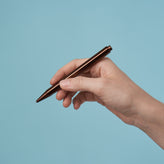
![[inside the studio]: a conversation with the designers of the Kolo Tino pen](http://www.paper-republic.com/cdn/shop/articles/TINO_PHOTOS-14_aa155863-7823-4e4e-81e5-333b8e9a6b48.jpg?crop=center&height=1024&v=1790243765&width=1024)
A pen is something we spend so much time with that we sometimes stop noticing it. With the Kolo Tino, that’s harder to do. But why?
We visited the Valentinitsch Design studio in Vienna to meet Tino Valentinitsch, whose name the pen carries, and fellow designer Michael Bauchowitz, to find out.

How did you meet the Topdrawer team, and how did the collaboration on the Kolo Tino pen begin?
Tino: It started with the smell artist Sissel Tolaas, whom I met at a gallery opening in New York. She developed a scent scanner that can scan people or cities, and she creates scents from what it captures. We always wanted to work together.
After I moved back to Vienna, she called me about a smell memory kit for Supersense. The idea was like a Polaroid, but with scent. We put unfamiliar scents into sealed ampoules that you could open during a moment you wanted to remember. Later, smelling that scent again would bring you back.
Through Supersense, we connected with Peter Dunn from Topdrawer. Jérôme from paper republic was also connected with them.
Peter had the Kolo brand, with only a few products at the time. We saw the pen as an opportunity to develop a recognisable identity for future products, too. So we were creating a design language as well as a pen.
Michael: Peter wanted new ideas and a new way of making a pen. He didn’t want to hear what couldn’t be done. He wanted to ask, “What more can we do?”

Was this the first pen you had ever designed?
Tino: Yes. That’s one of the most exciting things about our work: we get to work on so many different things. There’s no school where you can learn how to design a firefighter’s glove. Every project opens up a new world.
When you work within a company for a long time, you can become very immersed in your own world. Sometimes it’s hard to take a step outside and see the bigger picture.
We approach every project from a different angle. I think that’s also why Peter liked working with us. We didn’t know anything about pens at the beginning. It’s always an adventure.
Do you remember the first drawing of the pen? Is there anything from that initial sketch that made it into the final design?
Tino: Yes, pretty much. We explored different options in 3D and made models to see how they worked at their actual size.
Shape-wise, it has a fairly classic silhouette, inspired by pens from the twenties and forties with their smooth, rounded shapes. We wanted that smoothness, but we also wanted to give it a modern touch, so we cut off the sides. It fits really nicely in your hand, and it doesn’t roll away when you put it down.
It’s a classic silhouette with a little twist from those angled sides. We also wanted to emphasise the shape through the grooves, which point towards the tip and give you somewhere to grip.
Michael: You can also put the cap on the back, so you have a longer pen if you prefer that when you write.

Did you already have the materials in mind when you started designing, or did those come later?
Tino: Peter works a lot with sunglasses, and he found this amazing factory in Italy producing materials for high-end eyewear. We went there together.
It was a challenge to translate that into a pen because it’s a different material with a different weight.
Balance is important in a pen, just as it is with good cutlery. If the object balances more or less in the middle, that’s usually a good sign.
Michael: Materials like brass are heavier, so using them at the back of the pen affects the balance. We had to put the weight in the right place.
What makes an object good? Is there a quality you always look for, or does it change with every project?
Tino: It depends on the project. An object gives you possibilities for acting in everyday life. In a way, you’re designing a ritual, too.
Really good design should work with your natural habits, but it should also offer you new perspectives.
Especially when it comes to writing, doing something by hand gives it a certain importance. Even if you’re writing a shopping list, it’s a thoughtful process.
It’s about giving meaning to the little things you do every day, making those moments more valuable to you. There’s a kind of mindfulness in how you interact with your environment. Good design should open up possibilities.
For me, it’s really hard to imagine someone writing a really angry letter with this pen.
Michael: Or if they are angry, it must be about something really important.
Angry, but elegant.
Tino: Yes. A pen shouldn’t scream, “I’m a pen!” It should be there.
Design should make your everyday life easier. But when it does, there’s also a risk that you lose awareness of things because they become so obvious. “This is the pen.” and you don’t look at it anymore.

Do you remember the first thing you ever designed?
Tino: We had a little dachshund, and I came up with the idea of a hole in the middle of our dining table, with the dog’s bowl right underneath. You could put the dog’s food straight through the hole into the bowl. That was my first design. It was never made, but I sketched it out.
Michael: Thinking about it, my story isn’t quite as nice! I came from a more technical side. I think I started with a bicycle. I got a bike and gradually changed everything about it. I had the same bicycle for six years, but by the end, none of the original parts were left. That’s how I started.
What’s a memory from your childhood, or your past as a designer, that still influences how you work today?
Michael: I took everything apart and then put it all back together. My mum was always a little afraid, because I did it with electronic devices.
I think that’s still how I approach a new product. I take it apart to have a look inside, then put it back together in a new way.
Tino: My father was a designer, so I was naturally involved in that world. He also took me to design congresses.
Designers from all over the world came together in one place to think about current problems and work out how they could solve them. They also invited companies that had put projects into practice.
I was still a kid, but that was when I thought, “Oh, so design really can change something.”

When you look around in daily life, can you ever switch off your designer’s eyes?
“No!” They both answer immediately.
Michael: You can’t stop thinking about things. Why is it like that? What could we do better?
Tino: If you look around, pretty much everything is designed, whether it’s good design or bad design. There’s almost no environment that hasn’t been designed in some way.
So I feel really relieved when I’m in nature, for example, where I’m completely free from design. Although you could argue that it’s still designed by someone. Maybe. I don’t know. [looking up]
But I like these different approaches to design. Just because I don’t like a particular approach doesn’t mean it’s bad design. It might not work in one context, but work really well in another. I find that change of perspective intriguing.
Michael: That’s a question we’re often asked: “Is this good design?” And I always say we need to know what it was made for. What did they want to achieve? I can tell you whether I like it or not, but to say whether it’s good design, I need to know more about the product.

Since you mentioned nature, are there particular places or rituals you turn to for inspiration?
Tino: Everything.
Michael: Everywhere.
Tino: Especially rituals. Take the telephone, for example. When telephones still had cables, making a call was a different ritual from what it is today. You had to sit or stand somewhere with a bit of peace and quiet. You were tied to one spot and had to focus on the conversation.
Michael: And you didn’t know who would pick up. It might be someone’s father.
Tino: When we design new things, we need to be aware that we might lose a ritual or a habit while creating a new one. What will that look like? What consequences might it have? To be honest, I don’t think you can ever anticipate all the consequences.
Michael: There were quite a lot of nice accessories, but many disappeared as phones changed. Smoking has become less common, too. So there are opportunities to create new accessories, or bring old ones back.
What’s your favourite thing to design?
Tino: Ashtrays. I like them because they’re so simple: somewhere to put the ash and rest your cigarette, or whatever you smoke. It’s even more stupid than a chair, because it doesn’t do much. But there are so many ways to interpret it, and I find that fascinating.
Michael: The boring answer is always: the next project.

Is there something you’d love to design even if nobody ever commissioned or bought it? Something that sits in the back of your head?
Michael: I think we’ve already done quite a few of them. Watches, for example. That’s something I always wanted to do, and we did it with our own watch brand, AL-Time. That was one big dream.
As a student, I was always thinking about designing mobile phones. That was before the iPhone. Now it’s not so interesting to me.
Tino: In the past, I always wanted to design a car. Now I don’t think I need to anymore.
New technologies open up opportunities for new products. That’s something I really look forward to. We benefit from technology, and it also creates possibilities for something entirely new.
Take the pen, for example. A few years ago, the pen business was dead. Nobody was interested in buying a pen or a notebook. But partly thanks to these technologies, and because we’re human and still have the desire to touch things and do things, products like these are back. Maybe new products will come out of that, too.

About the designers
Tino Valentinitsch and Michael Bauchowitz lead Valentinitsch Design in Vienna, founded by Tino’s father, Dietmar, in 1982. Tino’s career took him into fashion, working with Yohji Yamamoto and later Helmut Lang in New York, before he returned to take over the studio in 2011. Michael joined in 2007 after working at design studios in Germany, bringing a background in mechanical engineering and industrial design.
Their work spans everyday objects and more unexpected inventions, including their own watch brand, AL-Time, and the Smell Memory Kit developed with Sissel Tolaas for Supersense. Each project brings a different set of questions about how an object is made and the place it might find in someone’s life. The Kolo Tino was their first pen.
See you at Vienna Design Week
The Kolo Tino pens will be on display at Design Everyday during Vienna Design Week, offering a chance to take a closer look at the details behind the design.
Paper republic is an official partner of the festival, and we’d love to welcome you to our events at [la maison] in Vienna. Come spend some time with us and continue the conversation in person.